
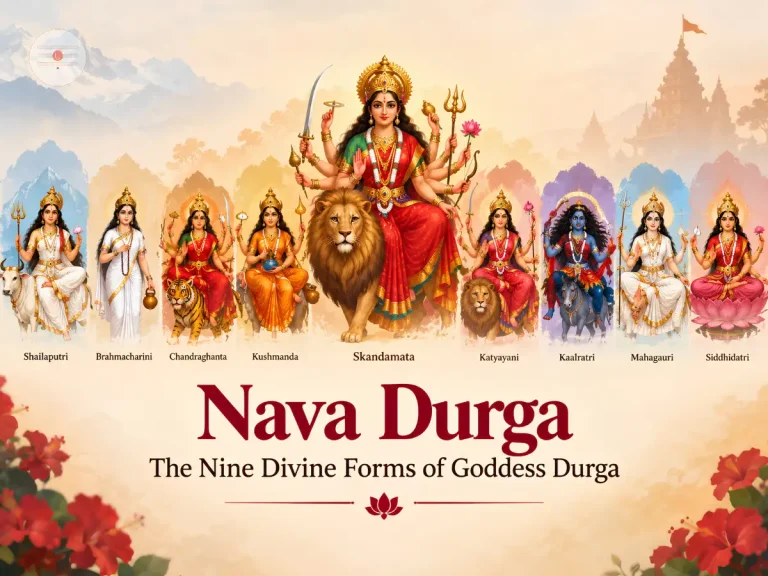
Nava Durga: The Nine Divine Forms of Goddess Durga
Nava Durga (नवदुर्गा) means the nine sacred manifestations of Goddess Durga, worshipped especially during the nine nights of Navaratri. Each form represents a particular dimension of Shakti, the divine feminine power, guiding the devotee from inner stability and devotion toward wisdom, fearlessness, and spiritual accomplishment.
To understand the deeper cultural context of this festival in Nepal, you can explore more about spiritual journeys and hiking experiences in Nepal, where faith and nature meet along sacred trails.
The Traditional Nine Forms
- Shailaputri: शैलपुत्री
- Brahmacharini: ब्रह्मचारिणी
- Chandraghanta: चन्द्रघण्टा
- Kushmanda: कूष्माण्डा
- Skandamata: स्कन्दमाता
- Katyayani: कात्यायनी
- Kalaratri: कालरात्रि
- Mahagauri: महागौरी
- Siddhidatri: सिद्धिदात्री
1. Shailaputri: The Daughter of the Mountain
Shailaputri (शैलपुत्री) means Daughter of the Mountain. She is traditionally regarded as the first form of Durga and is associated with Parvati, the daughter of Himavan.
She represents strength, stability, and the grounding of consciousness. Like a mountain, the spiritual seeker learns to remain steady despite the changing circumstances of life.
Spiritual message: Stand firmly in your dharma and begin your spiritual journey with stability.
2. Brahmacharini: The Power of Spiritual Discipline
Brahmacharini (ब्रह्मचारिणी) represents tapasya, devotion, self-discipline, and spiritual dedication. Her path reflects the discipline seen in many sightseeing tours that take devotees to powerful Shakti Peethas and temples across Nepal and India.
Spiritual message: Discipline transforms desire into devotion and effort into spiritual strength.
3. Chandraghanta: The Divine Bell of Courage
Chandraghanta (चन्द्रघण्टा) is recognized by the crescent moon resembling a bell upon her forehead. She represents courage, protection, alertness, and inner balance.
Spiritual message: Awaken courage within yourself and face fear with divine awareness.
4. Kushmanda: The Cosmic Creative Energy
Kushmanda (कूष्माण्डा) is traditionally associated with cosmic creative power and the source of life and energy. Her creative energy is also reflected in Nepalese heritage crafts, such as authentic cashmere cloth in Nepal.
Spiritual message: Recognize the divine creative energy within yourself and use it for life, service, and dharma.
5. Skandamata: The Divine Mother
Skandamata (स्कन्दमाता) is the mother of Skanda or Kartikeya, the divine warrior. She represents motherhood, compassion, protection, and unconditional love.
Spiritual message: Compassion is also a form of divine strength.
6. Katyayani: The Warrior Shakti
Katyayani (कात्यायनी) is a powerful manifestation of Durga associated with courage, justice, and the destruction of negative forces.
Spiritual message: Use your strength to protect dharma and overcome the obstacles within and around you.
7. Kalaratri: The Power Beyond Fear
Kalaratri (कालरात्रि) is the fierce form of the Divine Mother. Although her appearance is fearsome, she is traditionally regarded as a protector who destroys fear, negativity, and destructive forces.
Spiritual message: When fear is faced through spiritual awareness, it loses its power.
8. Mahagauri: The Radiance of Purity
Mahagauri (महागौरी) means the Great Radiant One. She represents purity, peace, compassion, and spiritual cleansing.
Spiritual message: Purification of thought, action, and intention leads toward inner peace.
9. Siddhidatri: The Giver of Spiritual Accomplishment
Siddhidatri (सिद्धिदात्री) is the ninth form of Nava Durga. She represents the culmination of the spiritual journey, the grace through which the seeker receives wisdom and realization.
Spiritual message: True siddhi is not merely supernatural power; it is the awakening of higher consciousness and realization of the Divine.
The Spiritual Journey of Nava Durga
- Shailaputri: Stability
- Brahmacharini: Discipline
- Chandraghanta: Courage
- Kushmanda: Creative Energy
- Skandamata: Compassion
- Katyayani: Strength and Dharma
- Kalaratri: Transformation of Fear
- Mahagauri: Purification and Peace
- Siddhidatri: Spiritual Accomplishment
Nava Durga and Navaratri
During the nine nights of Navaratri, devotees traditionally worship one form of Durga each day. Through puja, mantra, meditation, fasting, japa, havan, service, and contemplation, the devotee seeks the grace of Shakti. Many devotees plan their pilgrimages during this sacred time, and you can learn more about Nepal travel for Navratri and Dashain celebrations.
The deeper purpose is to transform fear into courage, ignorance into knowledge, weakness into strength, desire into devotion, and ego into surrender.
Sacred Invocation
॥ या देवी सर्वभूतेषु शक्तिरूपेण संस्थिता ॥
Yā Devī Sarvabhūteṣu Śaktirūpeṇa Saṁsthitā
To the Divine Goddess who abides in all beings in the form of Shakti, we offer our salutations.
॥ जय माता दी ॥ ॥ दुर्गा माताको जय ॥ ॥ ॐ ऐं ह्रीं क्लीं चामुण्डायै विच्चे ॥