
Seven Chakras – Seven Steps Towards Conscious Living
Guided by Prakash Bolakhe
Educational Philosophy: Nature • Energy • Consciousness • Spirituality
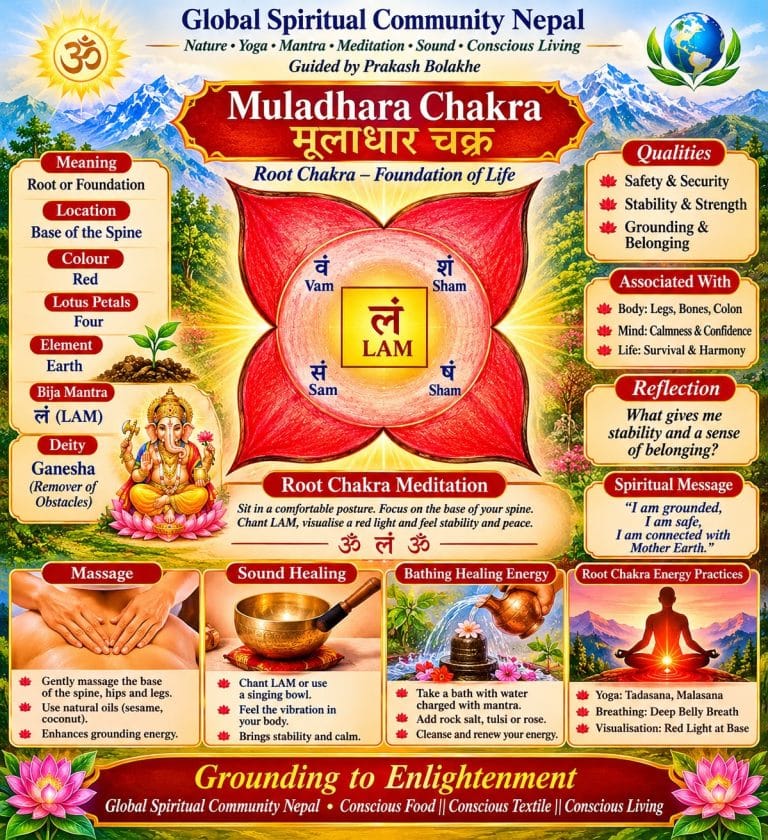
Chakra 1: Muladhara – मूलाधार
Root Chakra | Grounding | Safety | Stability
- Sanskrit meaning: Root or foundation.
- Location: Base of the spine.
- Traditional colour: Red.
- Lotus: Four petals.
- Element: पृथ्वी (Prithvi – Earth).
- Bija Mantra: लं (LAM).
- Petal syllables: वं, शं, षं, सं.
- Geometric symbol: Yellow square.
- Commonly associated qualities: Stability, security, survival, belonging and connection with nature.
- Traditional deity associations vary; Ganesha may be included in the GSC educational interpretation.
Learning Objective
Understand the importance of grounding, physical awareness, safety and a relationship with the natural world.
Practices
- Walking meditation in nature.
- Mountain and tree observation.
- Conscious breathing.
- LAM mantra chanting.
- Root Chakra sound meditation.
- Reflection on food, shelter, family and community.
Reflection
What gives me stability and a sense of belonging?
Chakra 2: Svadhisthana – स्वाधिष्ठान
Sacral Chakra | Acceptance | Creativity | Flow
- Sanskrit meaning: One’s own abode.
- Location: Lower abdomen.
- Traditional colour: Orange.
- Lotus: Six petals.
- Element: जल (Jala – Water).
- Bija Mantra: वं (VAM).
- Petal syllables: बं, भं, मं, यं, रं, लं.
- Geometric symbol: Crescent moon.
- Commonly associated qualities: Creativity, emotional awareness, adaptability, relationships and acceptance.
Learning Objective
Understand emotional awareness, creative energy and the natural flow of life.
Practices
- Water meditation.
- Conscious movement and gentle yoga.
- Creative art and natural colouring.
- VAM mantra chanting.
- Sound meditation.
- Journaling about emotions and acceptance.
Reflection
Can I accept change and allow life to flow naturally?
Chakra 3: Manipura – मणिपूर
Solar Plexus Chakra | Confidence | Discipline | Transformation
- Sanskrit meaning: City of jewels.
- Location: Navel region.
- Traditional colour: Yellow.
- Lotus: Ten petals.
- Element: अग्नि (Agni – Fire).
- Bija Mantra: रं (RAM).
- Petal syllables: डं, ढं, णं, तं, थं, दं, धं, नं, पं, फं.
- Geometric symbol: Downward-pointing triangle.
- Commonly associated qualities: Confidence, willpower, discipline, determination and transformation.
Learning Objective
Develop self-discipline, personal responsibility and confidence through conscious action.
Practices
- Surya Namaskar.
- Sunrise observation.
- RAM mantra chanting.
- Agni contemplation and safe fire rituals.
- Conscious eating.
- Personal discipline and daily sankalpa.
Reflection
How can I transform my intentions into meaningful action?
Chakra 4: Anahata – अनाहत
Heart Chakra | Love | Compassion | Harmony
- Sanskrit meaning: Unstruck or uncreated sound.
- Location: Heart centre.
- Traditional colour: Green.
- Lotus: Twelve petals.
- Element: वायु (Vayu – Air).
- Bija Mantra: यं (YAM).
- Petal syllables: कं, खं, गं, घं, ङं, चं, छं, जं, झं, ञं, टं, ठं.
- Geometric symbol: Interlocking triangles forming a six-pointed star.
- Commonly associated qualities: Love, compassion, forgiveness, gratitude and harmony.
Learning Objective
Understand the relationship between self-acceptance, compassion, family, society and all living beings.
Practices
- Loving-kindness meditation.
- Gratitude practice.
- Compassionate service (Seva).
- YAM mantra chanting.
- Nature and forest meditation.
- Acts of kindness towards people and animals.
Reflection
How can I bring more compassion into my daily life?
Chakra 5: Vishuddha – विशुद्ध
Throat Chakra | Expression | Truth | Communication
- Sanskrit meaning: Purification.
- Location: Throat region.
- Traditional colour: Blue.
- Lotus: Sixteen petals.
- Element: आकाश (Akasha – Ether/Space).
- Bija Mantra: हं (HAM).
- Petal syllables: अं, आं, इं, ईं, उं, ऊं, ऋं, ॠं, लृं, लॄं, एं, ऐं, ओं, औं, अं, अः.
- Geometric symbol: Circle, traditionally containing a crescent.
- Commonly associated qualities: Communication, truthfulness, listening, expression and purification.
Learning Objective
Develop responsible speech, attentive listening and authentic expression.
Practices
- Sanskrit pronunciation.
- Mantra recitation.
- Bhajan and devotional singing.
- HAM mantra chanting.
- Silence and listening meditation.
- Conscious communication.
Reflection
Do my words bring truth, kindness and harmony?
Chakra 6: Ajna – आज्ञा
Third Eye Chakra | Awareness | Intuition | Wisdom
- Sanskrit meaning: Command or guidance.
- Location: Between the eyebrows.
- Traditional colour: Indigo.
- Lotus: Two petals.
- Bija Mantra: ॐ (OM/AUM).
- Petal syllables: हं and क्षं.
- Symbol: Two-petalled lotus with the subtle geometric symbol associated with the chakra.
- Element: Beyond the five gross elements in the commonly taught chakra framework.
- Commonly associated qualities: Concentration, discernment, insight, observation and inner awareness.
Learning Objective
Develop concentration, self-observation, discernment and a deeper understanding of consciousness.
Practices
- Trataka (candle-gazing, with appropriate precautions).
- Breath-awareness meditation.
- OM chanting.
- Silent observation.
- Guided meditation.
- Study of Vedic philosophy.
Reflection
Can I observe my thoughts without being controlled by them?
Chakra 7: Sahasrara – सहस्रार
Crown Chakra | Universal Consciousness | Enlightenment
- Sanskrit meaning: Thousand-petalled.
- Location: Crown of the head.
- Traditional colour: Violet or white, depending on the teaching tradition.
- Lotus: One thousand petals (symbolic).
- Bija Mantra: No single universally prescribed bija mantra; silence and transcendent awareness are central in many interpretations.
- Element: Beyond the five elements.
- Symbol: Thousand-petalled lotus.
- Commonly associated qualities: Spiritual realization, transcendence, unity, wisdom and enlightenment.
Learning Objective
Explore the philosophical understanding of consciousness, interconnectedness and liberation.
Practices
- Silent meditation.
- OM chanting followed by silence.
- Spiritual reading and contemplation.
- Universal prayer.
- Gratitude and surrender.
- Selfless service.
Reflection
What does spiritual unity mean in my everyday life?
The Final Teaching
The seven chakras are presented as a progressive educational map of human experience and spiritual contemplation:
- I am grounded.
- I accept.
- I act with confidence.
- I love and serve.
- I express truth.
- I develop awareness.
- I contemplate universal consciousness.
Contact Us
- Kritipur, Kathmandu, Nepal
- +977-9851154156
- bolakheprakash@gmail.com
- bolakheprakash.com.np