
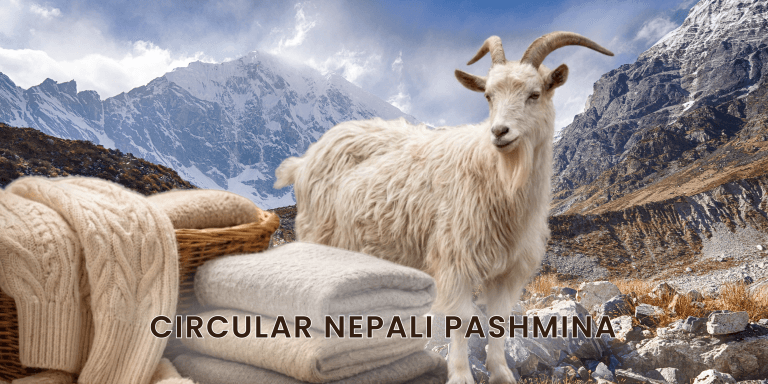
Nepal is uniquely poised where its rich past meets its sustainable future. By reinventing the conventional chain of production, Nepal has the potential to become a trailblazer in sustainable luxury by adopting the circular business strategy. Through this approach, Nepal can transform the existing industry from one that merely exploits resources to one that works within a loop while respecting the environment and celebrating Nepalese talent internationally.
Regenerating Raw Materials for Circular Nepali Pashmina
Sustainable luxury starts at high altitudes, where the Himalayas provide fertile pastureland for raising Chyangra goats. The process of preserving cashmere involves nurturing key ecosystems in the following ways:
- Sustainable Breeding Programs: We need to raise the number of Chyangra goats by increasing their healthy breeding population through scientific programs.
- Support for Pastoralists: Offering financial incentives will help sustain the traditional pastoral economy and protect Himalayan pastoral families.
- Land Management: Techniques like rotational grazing and conservation practices ensure that soil erosion is kept to a minimum.
- Traceable Product Lifecycle: Using technologies to trace cashmere from its source herding community to its final consumer.
Localized Value Retention in Circular Nepali Pashmina
Nepal had been exporting its raw and unprocessed fiber for years, leaving behind much economic gain abroad. To keep money in-country, it is crucial to establish an adequate processing system within the country itself. Local hubs can transform the whole manufacturing process:
- Fiber Gathering & Grading Centers: Establishing gathering centers allows for the timely and fair price of the gathered fiber according to its standard quality.
- Washing & Scouring Centers: Installing highly advanced domestic washing centers can clean the fiber properly and conserve local resources through recycling.
- Mechanical Dehairing Units: With dehairing equipment located in Nepal, fiber can be separated from coarse hair within the country itself.
- Spinning & Twisting Units: Processing centers can produce the high-quality yarn from the processed fiber for use in textiles.
- Local Garment Production: Setting up weaving, knitting, and design centers allows for more jobs within the industry for rural and urban areas.
Low-Impact Processing and Eco-Friendly Production
Luxury should not come at a price in terms of its environmental cost. Switching to green technologies during production will drastically reduce the environmental effect, as outlined in recent collaborative frameworks for Chyangra Pashmina Circular Economy Models:
Dyeing Facility: Establishing common facilities makes it possible for micro-businesses to use green dyeing facilities that utilize plants rather than chemicals. Likewise, local print workshops should be able to switch to water-based screen printing to get rid of toxic runoff.
Resource Management: Installing low-water machines will minimize waste. Implementing renewable sources of energy, such as solar or hydropower, in each facility will reduce dependence on fossil fuels and decrease the environmental impact of each product.
Zero-Waste Design in Circular Nepali Pashmina
The circular approach views production wastage as an important source of raw material for secondary industries. The manufacturer may sort out and collect waste on the factory floor and transform it into zero waste as follows:
| Waste Byproduct | Circular Transformation Lifecycle |
|---|---|
| Coarse Outer Fiber and Short Fibers | Transformed into heavy felt and agricultural insulation for home use. |
| Waste from Spinning and Weaving | Converted into blended yarn for accessories. |
| Sludge from Organic Processes | Treated to provide useful components for agricultural fertilizer. |
Global Branding and Experiential Retail
To compete with the mass-produced products, the industry needs to develop an identity that hinges on authenticity: “Authentic Nepali Chyangra Pashmina – From the Himalayas.”
Setting up experience boutiques in cities such as Thamel would enable tourists to interact first-hand with the craft’s history and its process from looms. Developing global flagship stores and overseas partnerships will connect the high-altitude farmers with luxury buyers abroad who seek ethical fashion options, creating a direct bridge to premium markets like cashmere in Norway.
Digital Supply Chains and Industry Connectivity for Circular Nepali Pashmina
Technology today makes mass production of artisan work possible. A unified digital platform overcomes the barrier of geography in order to maximize efficiency throughout the supply chain:
- B2B Platforms: Link high-altitude farmers with processing facilities, spinning mills, and textile companies, cutting out exploitative middlemen
- D2C Global E-commerce: Enables global buyers to purchase authentic and certified products directly from producers.
- Interactive Storytelling: Use QR codes on garments for full product provenance tracking featuring the herder, weaver, and environmental impact behind each piece.
Education and the Sustainable Investment Framework
Resilience over time requires a competent workforce. Building a dedicated Cashmere Academy prepares upcoming generations to acquire knowledge in veterinary science, grazing land management, fiber classification, textile designs, and international environmental, social, and governance (ESG) practices. To achieve this, our leadership remains deeply associated with global textile organizations to bring international standards to local institutions
This can only be achieved through resource integration between public and private sectors. Harnessing the strength of impact investments, grants from development partners, and favorable national policies would fund technological innovations, establish community-based processing plants, and provide green jobs for decades to come.